The French Love Medal: The Jewel That Binds Us
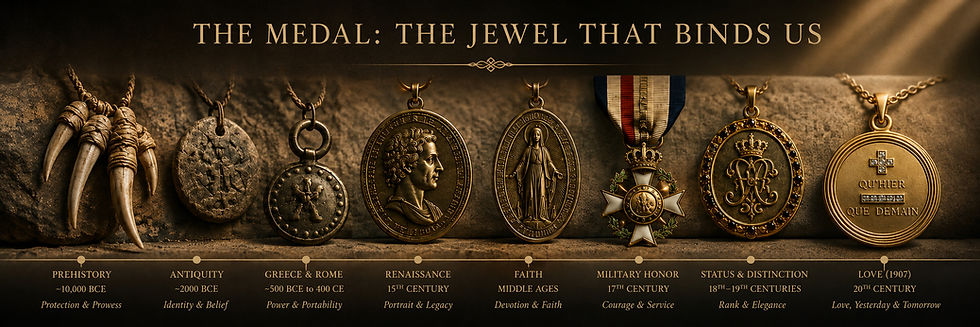
The Medal Through the Ages: From Protection or Glory to Love
Some jewels are made to adorn.
Others are made to remember.
The medal belongs to a rarer world.
For centuries, it has been worn not only for its beauty, but for what it carries: a symbol, a face, a faith, an allegiance, an honor, a memory, a love.
Small enough to rest against the skin, yet powerful enough to contain an entire story, the medal may be one of the most intimate objects humankind has ever chosen to wear.
Before the medal existed in the strict sense of the word, men and women were already wearing amulets, talismans, seals, pendants and sacred objects. They were carried for protection, recognition, devotion or belonging.
The forms changed.
The materials became more precious.
Gold replaced simpler metals. Engraving became finer. Portraits appeared. Gemstones entered the composition.
But the desire remained remarkably constant:
to give meaning a physical form, and to carry that meaning with us.
Perhaps this is what makes the medal so singular.
It connects us to something larger than ourselves.
And at the same time, it tells the world who we are.
1. The First Bond: Protection
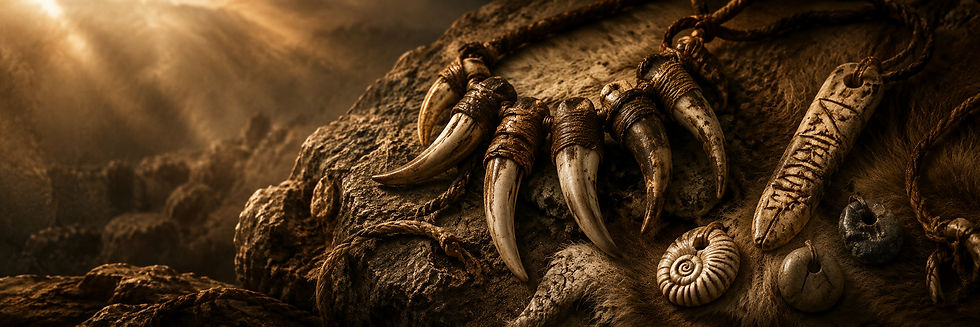
Before the Medal: The Protective Talisman
Long before jewelry became an expression of style, objects worn on the body could serve another purpose: protection.
Across civilizations, amulets and talismans were carried in the hope of placing an invisible force between the wearer and an uncertain world.
Protection against illness.
Against danger.
Against misfortune.
Against forces that could neither be understood nor controlled.
The object itself might be humble or precious, but what mattered was not decoration alone.
It was proximity.
It had to remain close.
Against the body.
Around the neck.
Within reach of the hand.
This simple gesture contains something profoundly human: when confronted with uncertainty, we choose an object, invest it with meaning and carry it with us.
Centuries later, the medal would inherit much of this intimacy.
The jewel would change.
The instinct would remain.
2. The Medal of Identity: Who I Am
Long before the portrait medal emerged in Renaissance Italy, human beings had already learned to wear identity.
Not as a document.
Not as a written biography.
But as a sign.
A seal.
A symbol.
A sacred image.
A name.
A figure.
An object worn close to the body could say something essential about the person carrying it: where they belonged, what they believed, whom they served, what rank they held, or how they wished to be remembered.
Sumer: When Symbols Began to Define the Individual
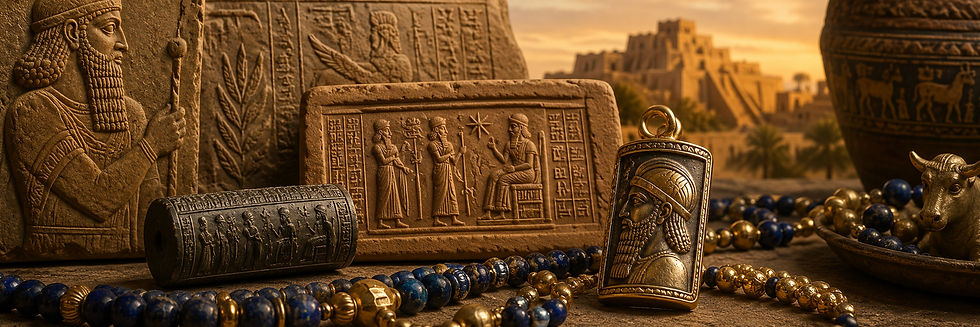
The First Signs of Identity — Sumer and the Birth of Belonging
In ancient Mesopotamia, and particularly in Sumer, identity was already deeply connected to objects, signs and images.
Cylinder seals are among the most remarkable examples.
Small enough to be carried on the body, they were engraved with figures, animals, gods, ritual scenes and inscriptions. When rolled across wet clay, they created a unique impression.
They could authenticate a transaction, identify an owner, mark authority or signal social position.
In a world without photographs, signatures or identity cards, the seal became a form of personal presence.
Its image stood in for the person.
Its imprint carried authority.
Its symbols could reveal status, profession, devotion or belonging.
The object itself might be worn, carried or suspended, making identity something both practical and intimate.
Already, one of the essential ideas behind the medal was present:
a small object could contain a person’s place in the world.
Egypt: Identity, Faith and Eternity

Egypt — The Ankh A Symbol of Life, Power and Eternity
Ancient Egypt added another dimension.
Here, identity could not be separated from belief.
Symbols such as the ankh, the scarab, the Eye of Horus, sacred animals and inscribed cartouches were not mere decoration.
They could express protection, divine order, royal authority, rebirth, social status and the hope of eternity.
The cartouche is especially powerful in this story.
To enclose a royal name within its shape was to give identity permanence.
To be named was to exist.
To preserve the name was, in a sense, to resist disappearance.
Jewelry and amulets could therefore carry something far deeper than ornament.
They could proclaim:
who I am.
Who protects me.
To whom I belong.
What I believe.
And how I wish to endure.
The ankh, worn close to the body, offers a particularly striking image of this fusion between identity and meaning.
It is not simply a beautiful form.
It is a statement of life, faith and connection to the sacred.
Greece and Rome: The Face Becomes Power

Greece and Rome — The Face Becomes Power
In the Greek and Roman worlds, identity becomes increasingly visible through the human face.
Coins, cameos, engraved gems and portrait objects carried the images of rulers, heroes, gods and important individuals.
The portrait gained political and social power.
A face could travel across an empire.
It could circulate from hand to hand.
It could assert authority in places the person himself would never visit.
The profile became a visual language.
A ruler’s identity was no longer confined to a palace or monument.
It entered daily life through metal.
This development is essential to the later history of the medal.
Because once the face becomes portable, identity becomes something that can be condensed, reproduced and carried.
A few centimeters of metal can hold not only a likeness, but an entire idea of power, legitimacy and memory.
The Middle Ages: Identity Through Faith, Lineage and Allegiance

The Middle Ages — Identity Through Faith, Lineage and Allegiance
During the Middle Ages, the expression of identity takes on new forms.
The individual is defined not only by the self, but by relationships of belonging.
Family.
Faith.
Dynasty.
Guild.
City.
Order.
Lord.
Kingdom.
Religious symbols become deeply personal markers, while coats of arms, seals, badges and insignia communicate lineage, authority and allegiance.
A person could be recognized through a crest.
A family through its arms.
A pilgrim through a badge.
A knight through heraldry.
A member of a group through an emblem.
Identity was read visually.
And once again, the object worn or carried played a central role.
The symbol became a social language.
To wear it was to declare:
this is my place.
This is my world.
This is where I belong.
The Renaissance: The Individual Steps Forward

The Renaissance — A Face, a Name, a Legacy
Then, in fifteenth-century Italy, something changes.
The individual steps forward with renewed force.
Humanism places greater emphasis on the person, on reputation, on achievement, on memory and on the desire to leave a trace.
The portrait medal becomes one of the most elegant expressions of this new consciousness.
The face is no longer only the face of a ruler or a god.
It can be the face of a patron.
A scholar.
A noblewoman.
An artist.
A humanist.
A military leader.
A person whose life deserves to be remembered.
The medal condenses identity into a remarkable form.
A portrait.
A name.
A title.
A symbol.
A few centimeters of metal.
And yet an entire life can be suggested.
The medal can be held.
Carried.
Offered.
Exchanged.
Preserved.
The individual becomes portable.
Memory becomes material.
And identity becomes something that can outlive the body.
From Sumerian seals to Egyptian amulets, from Roman portraits to medieval heraldry, the path is long.
But the human desire remains remarkably constant.
We have always sought to place ourselves inside objects.
To leave a sign.
To say:
This is who I am.
3. Faith: What I Believe

Faith — What I Believe
The medal would also become one of the most intimate expressions of faith.
A sacred image worn around the neck could create a private connection between the wearer and the divine.
A saint.
The Virgin.
Christ.
A cross.
A sacred emblem.
These were not merely decorative motifs.
They represented belief, protection, hope and devotion.
Throughout Christian Europe, devotional objects and jewels could be worn or carried as tangible expressions of piety.
Reliquary pendants and other precious religious ornaments sometimes combined gold, enamel and gemstones with deeply personal religious meaning.
This is one of the extraordinary qualities of the medal.
A cathedral is immense.
A sacred painting belongs to a place.
The medal travels.
It follows its owner into everyday life.
It crosses cities and borders.
It disappears beneath clothing.
It touches the skin.
Over years of wear, its surface may soften. Its relief becomes smoother. Gold or silver is polished by the fingers almost unconsciously touching it.
Faith leaves its trace on matter.
And matter, in return, helps keep faith close.
4. The Medal of Belonging

Symbols That Told the World Where We Belonged
Human beings rarely define themselves in isolation.
We belong.
To a family.
A city.
A nation.
A religion.
An institution.
A community.
And throughout history, symbols have allowed those affiliations to become visible.
The medal is exceptionally suited to this role.
Its small surface can contain an entire visual language.
An emblem.
A portrait.
A motto.
A crown.
An eagle.
A cross.
A date.
A few marks can be enough to tell another person:
we belong to the same world.
Jewelry has always had this extraordinary capacity to communicate without speaking.
A medal does it particularly well because it combines image, material and proximity to the body.
It is not simply an emblem observed from afar.
It is an emblem carried by a person.
5. Honor: The Military Medal

Courage, Service and Distinction
Nowhere is the relationship between belonging and distinction more visible than in the military medal.
A soldier belongs to a regiment, an army, a nation.
He may wear the same uniform as hundreds or thousands of others.
Yet a medal introduces individuality into that collective identity.
It records something.
A campaign.
A service.
A sacrifice.
An act of courage.
A distinction.
The military medal therefore says two things at once.
I belong.
And:
I have been distinguished.
This apparent contradiction is central to the history of the medal.
The same object that connects an individual to a group can also separate that individual from the group.
The medal creates equality through belonging and difference through recognition.
It makes membership visible.
But it also makes achievement visible.
6. The Jewel That Distinguishes

1920s — Beauty, Status and Refinement
And then there is beauty.
Because a medal is not merely a symbol.
It can also be a jewel.
Once goldsmiths, engravers, enamellers and stone setters enter the story, symbolic meaning begins to coexist with ornament.
Gold catches the light.
Engraving gives depth to the surface.
Enamel introduces color.
Pearls soften the metal.
Diamonds turn symbols into flashes of light.
Rubies, emeralds and sapphires transform a message into something precious.
At this point, the medal begins to speak another language.
The language of distinction.
A jewel made from rare materials and exceptional craftsmanship inevitably says something about the person wearing it.
Taste.
Wealth.
Status.
Refinement.
Access to beauty.
Here again, the medal refuses to be only one thing.
It can express humility and magnificence.
Belonging and privilege.
Shared belief and individual distinction.
The more beautiful it becomes, the more personal its presence becomes.

Art Nouveau — The Jewel as a Work of Art
7. The Medal of Love: When the Bond Becomes Intimate

Lyon, 1907 — The Birth of the Love Medal by Alphonse Augis
Eventually, the medal entered perhaps its most intimate territory.
Love.
The connection was no longer primarily between an individual and a religion, a nation or an institution.
It was between one human being and another.
And the transformation was profound.
The medal no longer needed to proclaim allegiance to the world.
It could become private.
Secret.
Tender.
7.1 Carrying a Face

1914–1918 — Before the Assault, He Carries the Face He Loves
The portrait locket is one of the most moving expressions of this transformation.
Its principle could hardly be simpler.
A jewel opens.
Inside is a face.
The person may be far away.
Travelling.
At war.
Separated by circumstance.
Or perhaps no longer alive.
Yet the image remains close to the body.
The locket creates an extraordinary illusion of proximity.
A person who is absent becomes present.
A face too precious to leave behind can be carried through daily life.
And because the portrait can remain hidden when the locket is closed, its meaning belongs first to the wearer.
A public jewel becomes a private world.
In this sense, the portrait locket may be considered one of the most intimate ancestors of the modern love medal.
It does something extraordinary.
It allows one person to carry another.
7.2 From the Face to the Symbol of Love

1930s — When Love Learned Its Own Language
But eventually, love no longer needed a portrait.
A heart could say enough.
Two initials could say enough.
A date could contain an entire life.
A few engraved words could hold a promise understood only by two people.
Sentimental jewelry gradually developed its own vocabulary.
The face could disappear.
The bond remained.
And something subtle changed.
The jewel no longer represented simply:
you.
It began to represent:
us.
This may be one of the most important transformations in the history of sentimental jewelry.
Love itself became the subject of the medal.
7.3 Alphonse Augis: When Love Becomes the Medal

1930s — When Love Learned Its Own Language
In France, this evolution reached one of its most enduring expressions at the beginning of the twentieth century.
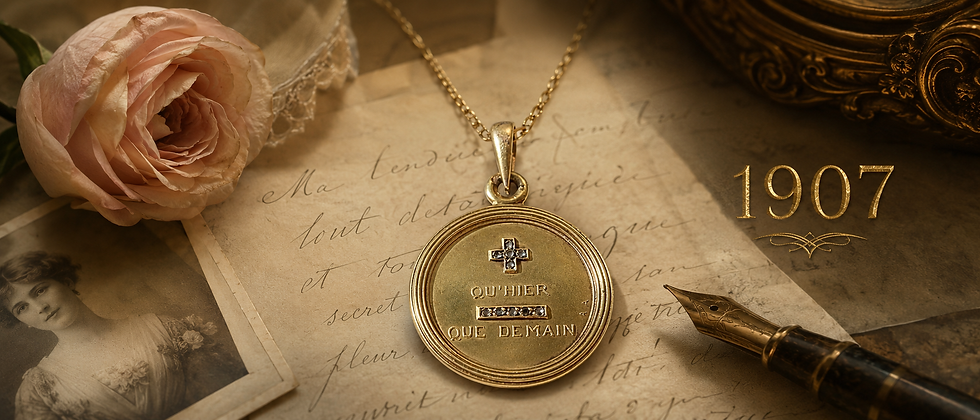
In 1907, in the workshops of Maison A. Augis in Lyon, Alphonse Augis created the Médaille d’Amour.
Its inspiration came from verses written by the poet Rosemonde Gérard in 'L'eternelle Chanson', expressing the idea of loving more today than yesterday, yet less than tomorrow.
Augis transformed those words into the now-iconic rebus:
+ qu’hier – que demain
The idea was remarkable.
Poetry became jewelry.
Words became symbols.
The plus sign and the minus sign no longer belonged to mathematics.
They belonged to love.
The medal itself had become the declaration.
It no longer needed to conceal a portrait in order to preserve the presence of the beloved.
It carried the relationship itself.
Few jewels achieve such economy.
A circle of gold.
A few words.
Two signs.
And an entire philosophy of love.
8. The Great Paradox of the Medal

Belonging and Distinction, Held in a Single Jewel, 1940s in Paris
Looking across its long history, one contradiction appears again and again.
The medal binds.
And the medal distinguishes.
A religious medal joins the wearer to a community of faith.
But the particular medal worn for decades becomes deeply personal.
A military decoration identifies a soldier with a nation or institution.
But it also distinguishes one life from another.
A family medal expresses lineage.
But only one individual may inherit it.
A precious medal can communicate membership in a world of refinement.
But its rarity separates it from the ordinary.
And the love medal links two people together while proclaiming that their bond belongs uniquely to them.
This is perhaps the medal’s deepest paradox.
It says:
I belong.
And at the same time:
I am singular.
9. A Few Centimeters of Metal. An Entire Life.

Aix-en-Provence, 1940s — A Love Medal Worn Through Time
There is something disproportionate about the medal.
It is small.
Often no larger than a few centimeters.
Yet what we ask it to carry can be immense.
Faith.
Identity.
Honor.
Status.
Memory.
Love.
Perhaps that is why medals so often survive their first owners.
The material remains after the moment has passed.
A medal given for love may eventually become a family jewel.
A religious pendant may come to matter as much for the grandmother who wore it as for the saint represented upon it.
A military medal can pass from history into memory.
The meaning of the object does not disappear.
It accumulates.
One life leaves its trace.
Then another life begins to carry it.
Gold is particularly suited to this passage through time.
It can be worn, scratched, polished, repaired and worn again.
The surface changes.
The object survives.
And sometimes the signs of wear become part of its beauty.
They reveal that the jewel has not merely existed.
It has lived.
10. The Medal Today

Evermine — A Contemporary Love Medal
We live in an age in which identity is increasingly immaterial.
Images disappear into screens.
Messages are stored in clouds.
Photographs exist without paper.
Words travel without objects.
And perhaps this makes the medal more fascinating than ever.
Because the medal remains physical.
It has weight.
Temperature.
Texture.
It catches the light.
It touches the skin.
You can hold it.
Give it.
Wear it.
Lose it.
Find it again.
And one day, pass it to someone else.
The medal transforms an idea into matter.
Perhaps that is why it has endured through so many civilizations, beliefs, fashions and generations.
Its meaning can change infinitely.
Its essential purpose does not.
It allows us to carry something that matters.
11. From Belonging to Love

Evermine — From Belonging to Love
The medal has carried gods and saints.
It has carried rulers and heroes.
It has celebrated victories.
It has proclaimed allegiances.
It has revealed rank and distinction.
It has protected.
Remembered.
Honored.
Identified.
And eventually, among all these immense ideas, it came to carry something profoundly simple.
The bond between two people.
Today, the French love medal continues to belong to this extraordinary lineage.
At Evermine, Toi & Moi Toujours is our own contemporary expression of that tradition.
Not a reproduction of the past, but a continuation of the idea that has made the medal endure:
that a precious object can give physical form to an invisible bond.
Three words.
You & Me, Always.
Perhaps this is the secret of the medal.
Some jewels are worn simply because they are beautiful.
The medal can certainly be beautiful.
But we rarely wear it for beauty alone.
We wear it because it means something.
And what we choose to carry closest to the heart has never been merely decoration.
The History continues.........


Comments